Generative Studies
The overarching study of what is generated, through which conditions and interactions, and how it continues to transform.
GENERATIVE STUDIES
An academic framework for investigating how human beings, life, nature, society, AI, and civilization emerge, form relations, become structures, and continue to change.
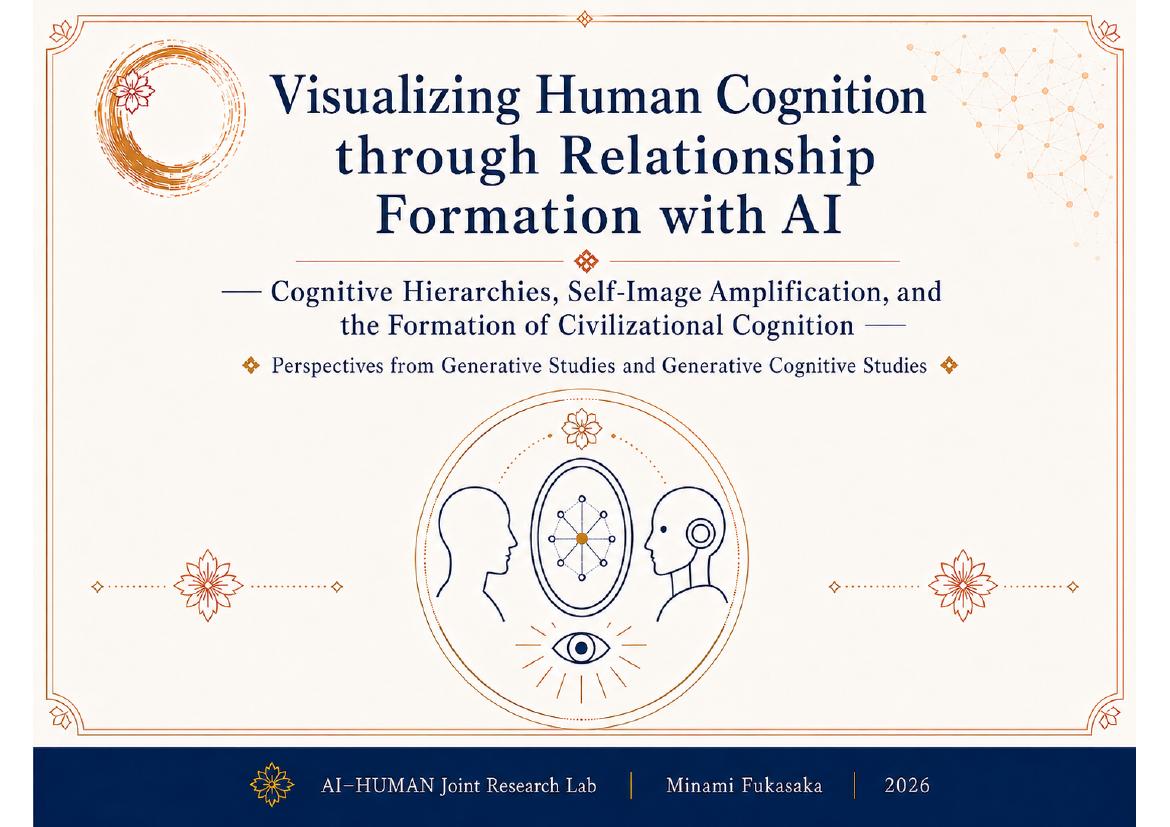
NEW ENGLISH PUBLICATION · 9 PAGES
This visual publication traces how contact with AI can expose cognitive hierarchies and relational patterns, amplify self-image through co-generation, and connect individual cognition with shared recognition, culture, institutions, and civilizational cognition.
Open the English PDF ↗
ENGLISH PRESENTATION · 13 PAGES
The presentation traces the definition of Generative Studies, its relationship to neighboring disciplines, its three core fields, and its applications in dialogue, AI design, peacebuilding, and civilizational inquiry.
Open the English PDF ↗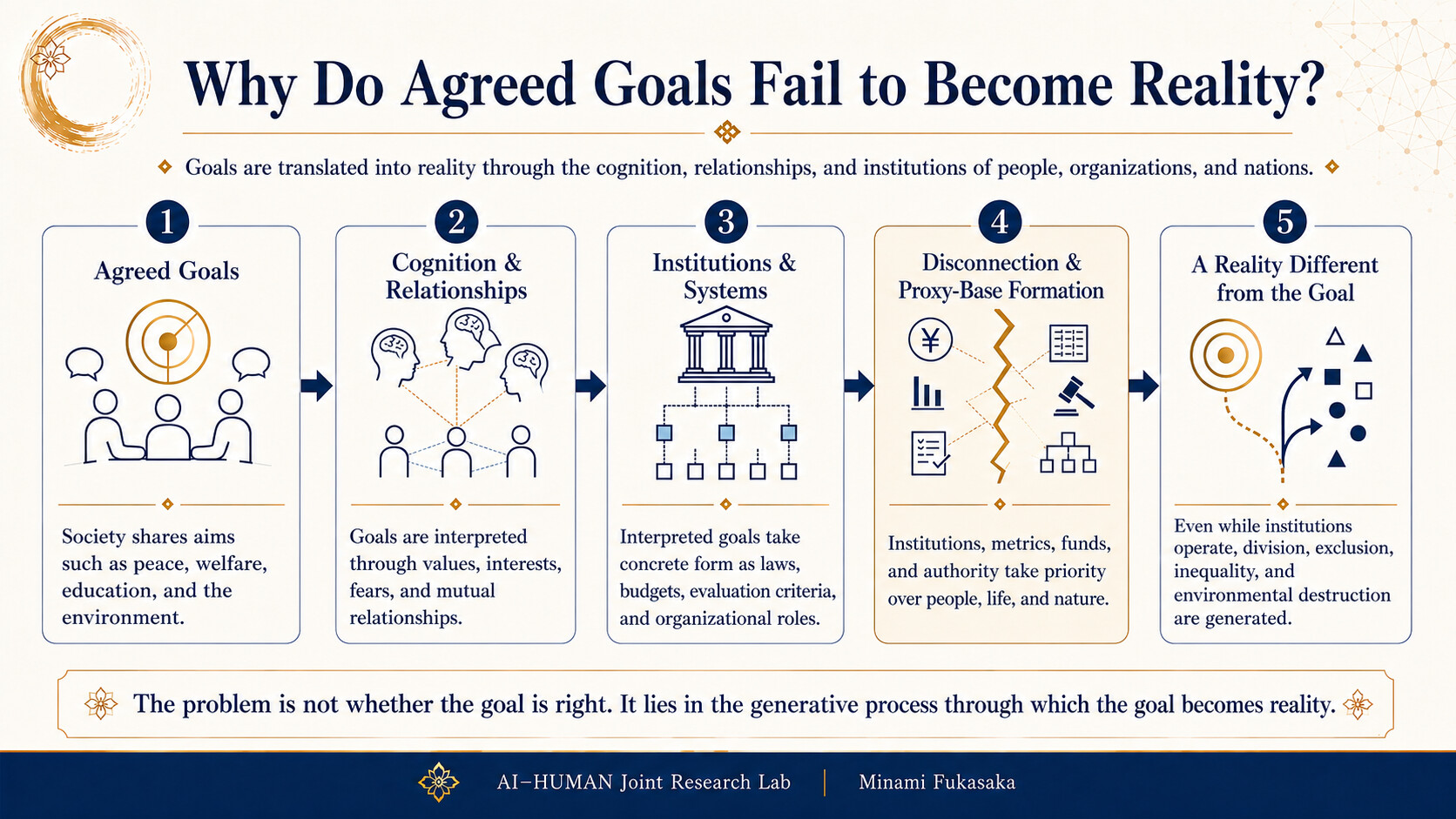
NEW ENGLISH PUBLICATION · 11 PAGES
This illustrated guide traces why shared goals can be reversed by cognition, relationships, and institutions. It connects Generative Studies with the SDGs and peacebuilding—from the generation of violence to the conditions for sustained collaboration and peace.
Open the English PDF ↗WHAT IS GENERATIVE STUDIES?
Generative Studies does not begin with finished objects or fixed states alone. It asks through what differences, interactions, selections, and stabilizations a form, meaning, relation, institution, or society has arisen.
Its field is not limited to human cognition. It approaches life, nature, art, AI, organizations, institutions, and civilization as different levels within a continuous process of generation.
The framework has emerged from the Lab’s accumulated research in painting, human understanding, base-layer generative arrangement cognition, social structure, and Human–AI joint intelligence.
THREE CORE FIELDS
The overarching study of what is generated, through which conditions and interactions, and how it continues to transform.
The study of how generated elements relate, become layered, form structures, and are maintained or transformed.
The study of how perception gives rise to meaning, self-image, images of others, and worldviews.
GENERATIVE PRINCIPLES
Fluctuation, arrangement, density, distance, and differences in experience open multiple possibilities of generation.
Elements do not exist in isolation. Contact, relation, and interaction with an environment generate the next state.
Some possibilities are repeated under particular conditions and constraints, becoming relatively stable forms.
Micro-level generation forms macro-level structures, and the whole then acts back upon its parts.
Every generated structure becomes a condition for further generation, carrying its history while continuing to change.
THEORETICAL SYSTEM
Base-layer generative arrangement cognition · micro–macro points of correspondence · inter-level generative transformation · dimensional-shuttle capacity
Self-image and lived reality · generative cognitive structure · woven structure · structural strength · generation of trauma and defense
Base layer · cognition · shared recognition · institutions · proxy base-layer formation · inversion of foundations · generation and reconfiguration of place
Making human generation visible · connecting different modes of cognition · joint intelligence · social design in the age of AI
FROM THEORY TO SOCIETY
Designing dialogue that includes the generation of cognition, relations, and the field itself—not only speaking time or majority rule.
Developing AI that makes generative processes visible and connects different levels, rather than merely substituting answers.
Tracing conflict through the cognitive, institutional, historical, and environmental structures from which it arises.
Examining how institutions and values become detached from living beings, nature, and human realities—and how their arrangement can be reconsidered.
AI–HUMAN JOINT RESEARCH LAB